
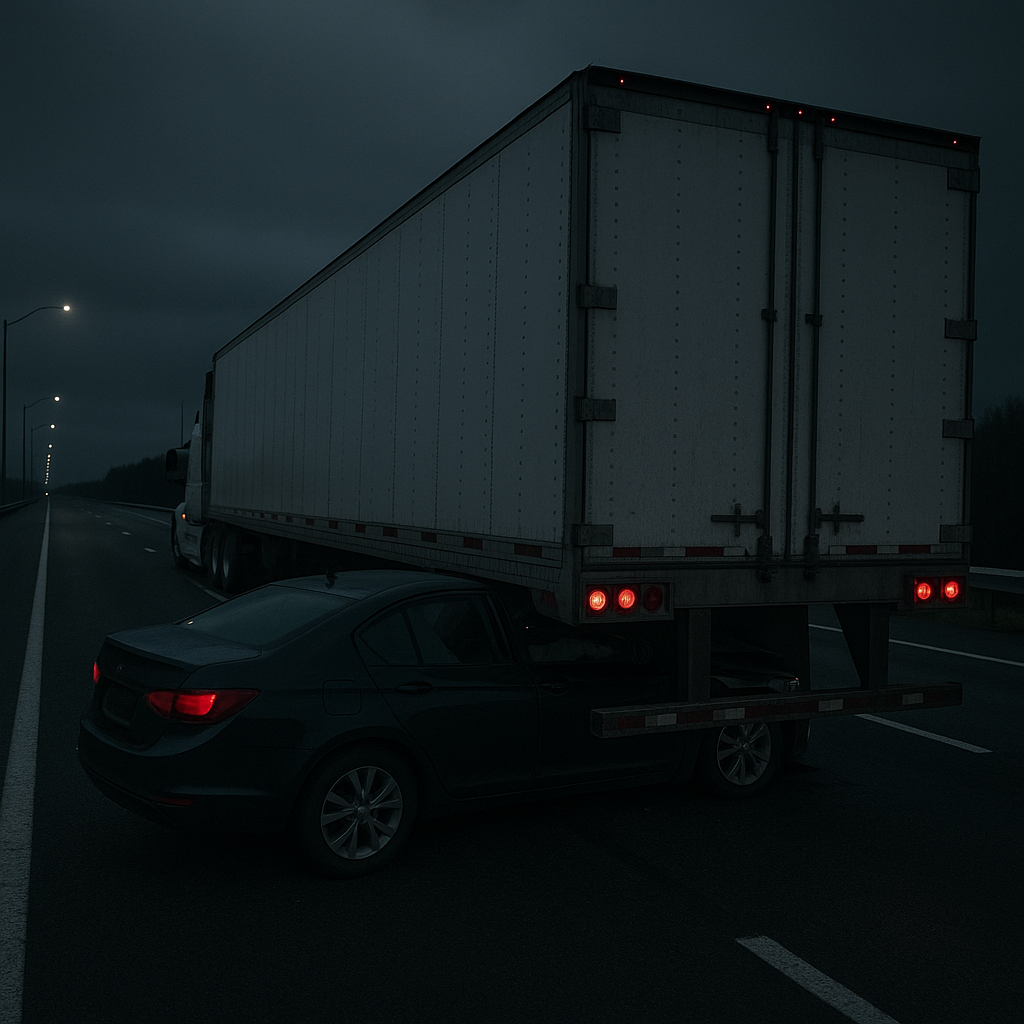
Underride Crash on Poorly Lit Highway
An underride crash on a dark highway is a type of incident where a smaller vehicle slides beneath the rear or side of a much larger truck or trailer. These collisions are especially dangerous, often happening on highways with poor lighting, making it difficult for drivers to see large vehicles in time.
Such crashes tend to occur at higher speeds due to the nature of highways, and darkness further reduces visibility. Many individuals wonder what typically unfolds in these situations, what consequences follow, and what can be done to reduce risk.
What Typically Happens During a Dark Highway Underride
An underride event can unfold in just seconds. On stretches of highway with minimal illumination, drivers may not spot a slow-moving or stopped truck until it is too late to stop safely.
Limited Visibility and Reaction Time
On a poorly lit highway, the darkness masks the presence of a truck or trailer, especially if its reflective markings or lights are not fully functional. A car approaching at highway speeds may only identify the outline of a trailer at the last moment. During this critical moment, a limited window exists in which the driver can react—often not enough time for a complete stop.
Positioning of Vehicles and Results
In many scenarios, a car collides with the rear or side of a trailer, the front end of the car going under the higher bed of the truck. The outcome for occupants varies depending on speed, position, and the presence of underride guards. Trucks equipped with well-maintained guards may help prevent a worst-case scenario, but these measures are not always present or effective, particularly with aging vehicles.
Aftermath of a Nighttime Underride Crash
After an underride crash on a dark highway, a series of physical and practical developments typically follow.
Immediate Physical Outcomes
First responders usually arrive at the scene to assess injuries and facilitate aid. The structure of most cars offers limited protection in an underride, so medical attention is often required for those involved. Emergency lights and additional vehicles may need to be deployed to make the area more visible to other drivers.
Scene Management and Safety Measures
Authorities commonly secure the affected stretch of road to prevent further incidents. They also investigate the visibility conditions at the crash scene, sometimes noting missing or damaged roadway lighting, inadequate signage, or obstructed views from curves and inclines.
Practical Impacts on Traffic Flow
Dark highway underride crashes can cause long delays. Lane closures may be needed to clear debris and allow necessary investigation. Traffic may be redirected to secondary routes for several hours, especially if hazardous materials or heavy equipment are involved.
Common Concerns Following an Underride Accident
Many people find themselves contemplating a range of questions afterward.
Questions About Highway Safety
It is not uncommon for witnesses or those living nearby to ask how similar incidents can be prevented. Discussions often touch on the adequacy of highway lighting, the effectiveness of reflective materials on trucks, and the importance of regular safety inspections. Drivers may also reconsider their nighttime travel habits.
Considerations for Vehicle Equipment
Some wonder about the role of underride guards and whether older trucks are subject to the same safety standards as newer models. While equipment updates can reduce risk, challenges remain in ensuring consistent road safety across all types of heavy vehicles.
The Role of Environmental Factors
Poor weather, lack of road markings, and sharp bends can play a role in these incidents. People frequently express concern about how comprehensive maintenance and modern lighting systems can further improve nighttime road safety.
Reflecting on Underride Events in Low-Light Conditions
Reviewing incidents involving dark highway underride crashes highlights the complexity of nighttime driving environments. Reduced visibility, combined with high speeds and the presence of large vehicles, can lead to challenging and hazardous conditions. Understanding how these crashes unfold, their aftermath, and the broader questions they raise contributes to ongoing discussions about improving highway safety for all travelers.