
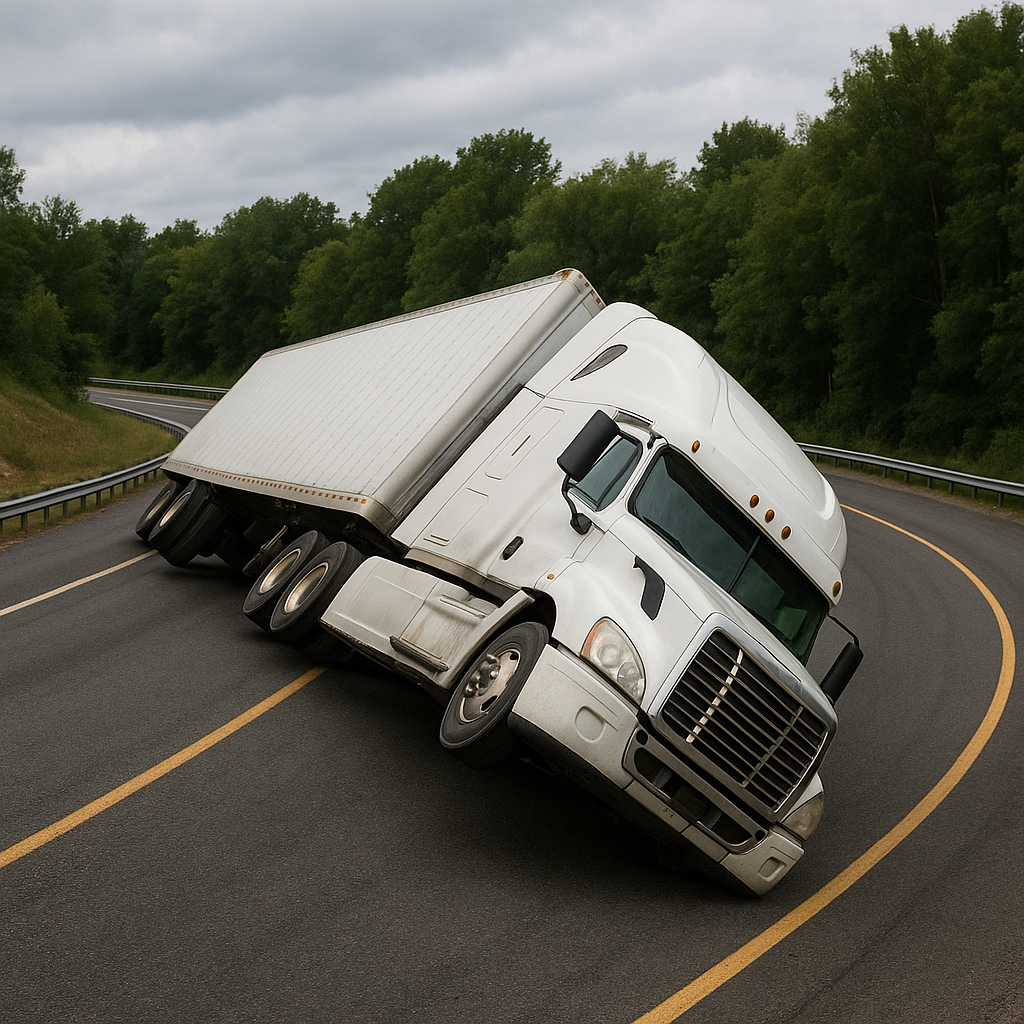
Semi Rolled Over Due to High Speed on Curve
Why Is the Cause of a Semi Rollover on a Curve Often Questioned?
When news spreads that a semi truck has rolled over after taking a curve too quickly, people frequently want to understand the underlying reasons. Many drivers regularly travel near large trucks and are aware of their size and distinctive driving behavior; seeing a semi overturned can prompt questions about highway safety and the factors that contribute to such incidents. This curiosity is further fueled by concerns over road safety and the specific challenges that commercial truck drivers face when navigating highways and sharp turns.
Questions also arise because semi rollover incidents can disrupt traffic, cause delays, and in some cases, involve multiple vehicles. Spectators and motorists alike may want insight into how such accidents unfold, especially when the incident appears as dramatic as a large vehicle overturning. Understanding the nature of these events can help the public better grasp the risks associated with high-speed driving on curves and the reasons these situations develop.
Understanding the Mechanics of High Speed Curve Rollover
A semi being involved in a rollover while navigating a curve at high speed typically relates to fundamental physical forces acting on the vehicle. When a truck enters a bend too quickly, the lateral or “sideways” forces increase significantly. Unlike passenger cars, semis possess a much higher center of gravity due to their design and heavy loads. This makes them more vulnerable to tipping over when cornering at speeds above what is recommended or safe for their size and load.
As speed increases on a turn, the force that pushes the semi outwards—away from the center of the curve—rises exponentially. This can quickly exceed the truck’s ability to remain upright, especially if the cargo is not evenly distributed or is loosely packed, compounding instability. Once the balance is lost and the center of gravity shifts too far, a rollover can occur in moments, giving little time for corrective action.
Less Apparent Details About Semi Truck Rollovers
There are nuances to high speed curve rollover incidents that might not be obvious to those who do not drive large commercial vehicles. Weather conditions can play a significant role, as rain, ice, or loose gravel make tire grip less reliable, reducing the truck’s margin for safe cornering. Road shape and banking are also influential; curves that are flat, or even banked in the wrong direction, can dramatically reduce the speed at which a truck can safely travel.
Load type and cargo distribution further complicate the situation. A fully loaded trailer with a shifting or top-heavy cargo is inherently more difficult to control on curves. Liquid payloads, such as fuel or milk, are even more susceptible due to the “sloshing” effect that occurs during sharp motions. Even empty or lightly loaded trailers can be more prone to rollover since there may be less downward force anchoring the wheels to the road.
Human factors often come into play as well. A driver may misjudge the radius of a curve, feel pressured to meet tight deadlines, or may not be familiar with a particular stretch of road. Fatigue and distractions, while issues for all drivers, can have amplified effects in trucks due to their demanding handling characteristics and enormous mass.
Vehicle maintenance sometimes contributes to rollovers. Components like suspension systems, tires, and brakes must be in optimal condition to handle the complex forces encountered in high speed turns. Underinflated tires or worn-out shocks increase the risk of instability when making abrupt maneuvers or dealing with uneven roads.
Informational Perspective on Preventing Similar Incidents
While high speed curve rollover accidents involving semi trucks might seem sudden, they are often the result of numerous interacting factors. Understanding the vulnerabilities of large vehicles—especially their tendency to tip under lateral stress—clarifies why even a small error in speed or judgment on a curve can have large consequences.
Drivers of all vehicles can benefit from keeping a safe distance from trucks, particularly on curvy roads, and being aware that these vehicles require much more time and space to navigate safely. Highway engineers continue to improve signage and road design to minimize risks associated with sharp curves, but adjustments in load management, speed awareness, and vehicle maintenance remain crucial defenses against future rollovers.
Awareness of these complexities provides a more complete picture of why a semi might roll over at a high speed on a curve, underlining the importance of caution, preparation, and respect for the unique physics at play in large vehicle operation.