
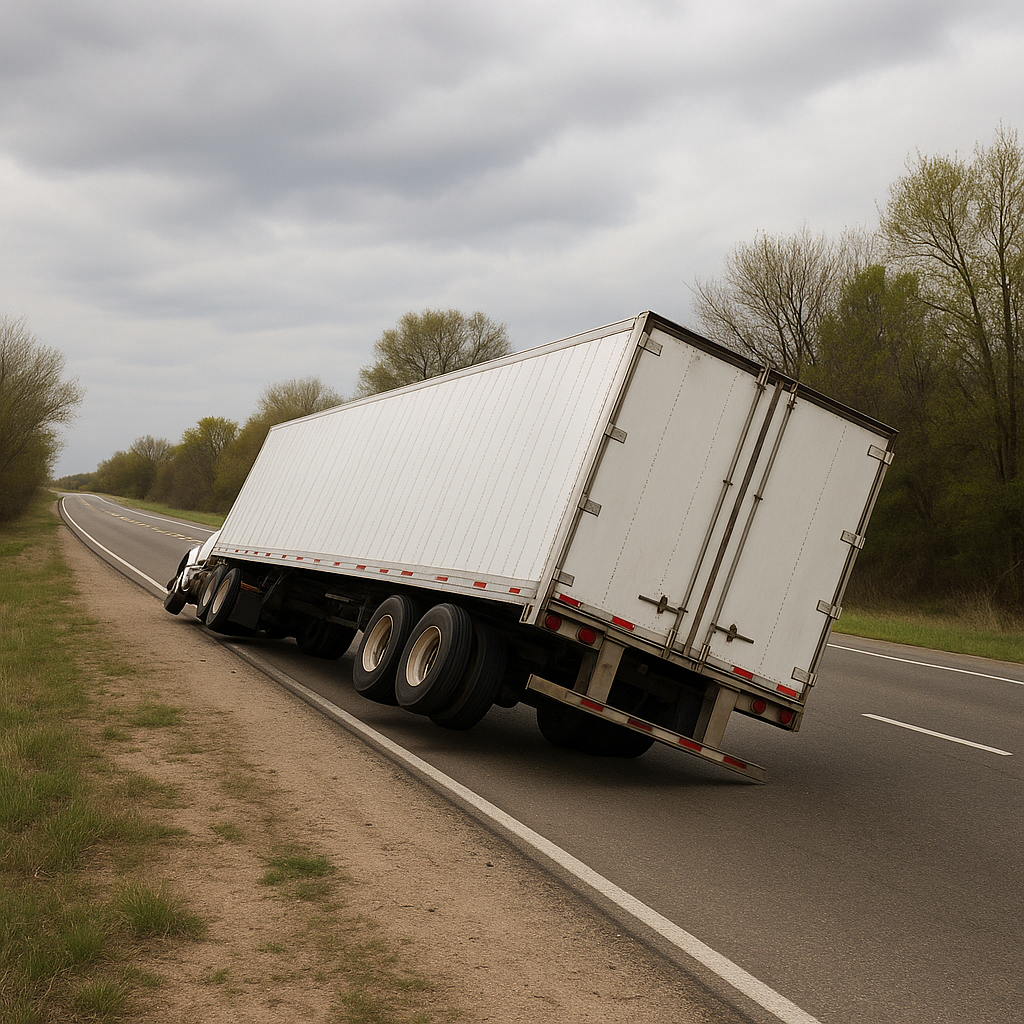
Why Empty Trailers Roll Over More Easily
When trucks lose stability and overturn—an event known as a rollover—the results can be dramatic and dangerous. While rollovers can occur with fully loaded trailers, empty trailers roll over more easily, and with surprising frequency. Understanding the reasons behind this phenomenon requires exploring the dynamics of commercial vehicles, the physics of mass and motion, and the real-world outcomes seen on highways. This article examines the causes and consequences of empty trailer rollover incidents, offering an educational perspective on this recognizable risk in freight transport.
The Dynamics Behind Empty Trailer Rollovers
Mass and Stability in Heavy Vehicles
The stability of a trailer, whether loaded or empty, hinges on its physical properties. Filled trailers have a substantial mass distributed relatively low to the ground. This load acts as ballast, anchoring the trailer’s center of gravity.
An empty trailer, in contrast, has much less mass. Its weight is not only lower but distributed higher—with much of the remaining mass located above the axles, in the superstructure of the trailer itself. The result is a naturally higher center of gravity relative to the axle line, and a significant reduction in the “anchoring” force that keeps the trailer’s base pressed against the road.
Reduced Downward Force
Weight exerts a downward force, increasing the friction between tires and asphalt. This friction is a truck’s primary defense against destabilizing forces like wind or sharp turns. When a trailer is empty, the loss of weight creates less tire grip. This makes the wheels more likely to lose their hold on the road during sudden maneuvers or gusts of wind. The effect is amplified at highway speeds or in adverse weather conditions.
Impact of Lateral and Wind Forces
Any trailer, due to its size, acts like a sail when crosswinds blow. A loaded trailer resists being pushed sideways, as the heavy contents counteract the force. An empty trailer has no such internal resistance. Lateral wind pushes more effectively against its lighter, hollow structure, causing it to sway or tip.
Cornering or swerving, too, imposes lateral forces. In a loaded trailer, the cargo weight helps keep the trailer planted, making it harder to tip. An empty trailer, with its lighter mass, is often more prone to rolling over when subjected to similar sideways forces, whether from a sudden steering input or evasive maneuver.
How Empty Trailer Rollover Occurs
The Role of Inertia and Momentum
When a truck encounters a sharp curve at speed, the force of inertia pushes the vehicle outward. The amount of force required to tip a trailer depends on its mass and how that mass is distributed. The heavier and lower the mass, the harder it is to tip. When a trailer is empty, its inertia is low, meaning it takes less force—whether from wind or steering—to unsettle it. As it starts to tip, there is less weight on the far-side tires, which can cause them to lift off the ground. Once the center of gravity passes the axle tipping point, the rollover becomes almost inevitable.
Suspension and Flex
Trailer suspensions are designed to handle loads. An empty trailer rides higher and stiffer, with less compression in its springs and bushings. This increases the likelihood of the trailer “skipping” or bouncing during rough road conditions. The resulting instability further reduces the margin of safety during turns or evasive maneuvers.
Hollow trailers can also experience flex and twist in the frame, which is easier to control when cargo is present to hold the structure rigid. Without this mass, the trailer’s body is more easily flexed by outside forces, making rollovers more probable in extreme situations.
Center of Gravity and Vehicle Dynamics
The height of the center of gravity is a decisive factor. With no heavy load anchoring the trailer, the inherent structure—walls, roof, support beams—comprises the bulk of the weight, often relatively high above the axles. A higher center of gravity makes any top-heavy object more likely to fall over, a principle clearly at play in empty trailer dynamics.
When road conditions change abruptly—think sharp curves, exiting highways, uneven surfaces, or emergency maneuvers—the destabilizing forces interact with the vehicle’s naturally less stable geometry. These forces combine to boost the likelihood of an empty trailer rollover, even when driving at moderate speeds or in seemingly safe conditions.
Empty Trailer Rollover in Crash Data and the Real World
Frequency and Conditions
Empty trailer rollovers are not just a theoretical hazard. Crash data and case studies reveal that a significant percentage of rollover incidents involve trailers with little or no interior cargo. These incidents are often clustered around certain scenarios: high wind corridors, exit ramps with tight curves, or sudden maneuvers to avoid obstacles. Unlike the classic image of a heavy, tipping load causing a crash, many rollovers occur precisely because the trailer lacked the stabilizing effect of cargo.
Roadway and Environmental Factors
Drivers encounter many challenges on highways—inconsistent weather, freezing rain, patchy pavement, and winding roadways. For an empty trailer, these ordinary driving hazards become more dangerous. The lack of mass increases the sensitivity of the vehicle to external disruptions. In rural areas or open terrain, gusts of wind can easily catch the side of an empty trailer, leading to sudden loss of stability. In urban settings, the physics of empty trailer rollover may come into play during tight turns and stop-and-go maneuvers.
Secondary Impacts and Response
When an empty trailer rolls over, the consequences reach beyond the vehicle itself. Traffic disruption, secondary collisions, and road closures are all frequent outcomes. The scattered debris and obstructed lanes may trigger further incidents as approaching drivers must suddenly react or swerve. Responding to such events often involves extended recovery times, owing both to damaged vehicles and the logistical challenges of righting and towing large, overturned trailers.
A Balanced Perspective
Awareness of the tendencies of empty trailers to roll over more easily than loaded ones is a product of both physics and experience. The absence of cargo dramatically alters the vehicle’s balance, stability, and resistance to wind or sudden steering inputs. Empty trailer rollover remains a critical topic for transportation safety research and operational awareness across the freight industry. By examining the mechanics and real-world outcomes of this phenomenon, a better understanding of vehicle dynamics and the contributing factors to rollover incidents emerges, providing context for the ongoing study of truck safety and roadway engineering.