
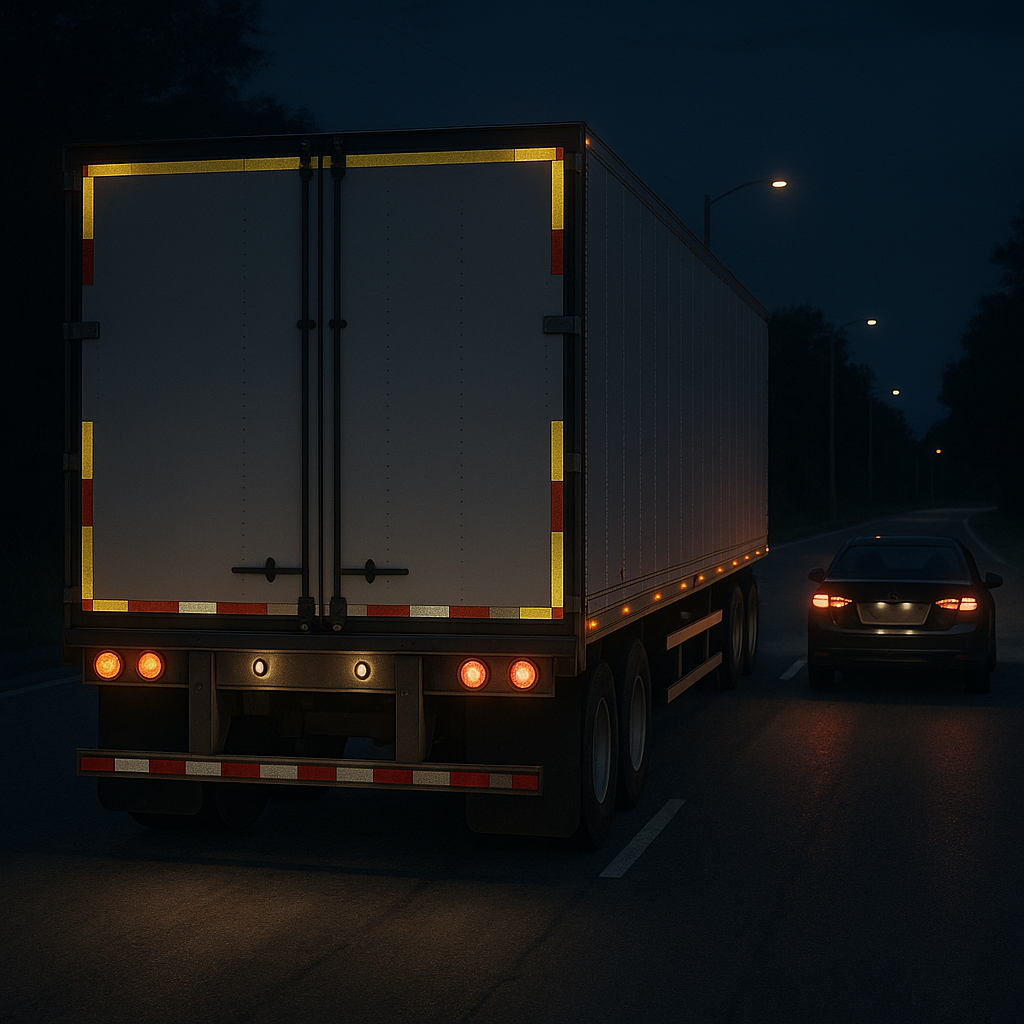
Why Trailer Visibility Matters at Night
Trailer visibility at night is a crucial factor that often goes overlooked in discussions about road safety. When traveling after dark, trailers, whether attached to trucks, RVs, or other vehicles, become harder to detect compared to their daytime presence. The challenges associated with trailer visibility at night can create significant hazards for all road users. Numerous incidents and studies have highlighted the impact of low visibility on nighttime crashes, emphasizing the importance of improving awareness of this hidden risk.
The Science of Visibility
Light, Reflection, and Human Perception
Visibility on the road, particularly at night, relies on a combination of factors including lighting, reflective surfaces, and human visual perception. Trailer visibility at night becomes challenging primarily due to the limitations of human eyesight in low-light conditions. Without adequate lighting or reflective markers, trailers can blend into the background or become visually camouflaged by the road environment.
Human vision is naturally less sensitive in darkness. Most people depend heavily on artificial lighting—such as headlights—to illuminate the path ahead. However, headlights are only effective at detecting objects that reflect or scatter light back to the driver. Trailers lacking proper retroreflective tape, functional taillights, or side markers may not provide enough visual cues for other drivers to notice them until it’s too late.
The Physics of Illumination and Contrast
Contrast is key to nighttime detection. During the day, even matte or dull surfaces become visible due to ambient light. At night, the absence of background illumination means that only objects that reflect or emit light create noticeable contrast. Many trailers are painted in dull colors or have surfaces that do not effectively reflect headlights, especially from side angles. The problem is amplified on dark rural highways, where there is little to no ambient lighting.
Certain weather conditions—such as rain or fog—can exacerbate the situation. Water on trailer surfaces can diffuse light rather than reflect it directly, reducing visibility further. Dirty, damaged, or missing reflective materials on trailers also contribute to the problem.
Trailer Systems and Reflective Devices
Federal and industry regulations often require trailers to be equipped with systems designed to improve visibility at night, such as reflectors, conspicuity tape, and functioning tail, brake, and side marker lights. Reflective tape and markers are designed to reflect headlights from approaching vehicles, allowing drivers to identify the outline of a trailer ahead or beside them. These safety systems can deteriorate over time. If not properly maintained, even the best systems lose their effectiveness, reducing the margin drivers have to react to a trailer obstructing their path.
How Poor Trailer Visibility Contributes to Crashes
Sequence of Nighttime Collisions
The sequence of events in nighttime crashes involving trailers often starts with a simple failure to detect. A driver traveling at highway speed encounters a trailer, particularly from the side or rear, and does not recognize it in time to stop or swerve. This scenario is common at intersections where trailers are crossing or backing onto the road or on highways where a slower-moving vehicle is not clearly marked.
Low-visibility trailers can seem almost invisible until a vehicle’s headlights are close enough to illuminate them at a practical angle. This delayed detection significantly limits the reaction window for a following driver, especially at faster speeds. The result can be full-speed impacts into the sides or rears of trailers, collisions that frequently lead to severe outcomes.
The Human Factor
Cognitive load also plays a role. Drivers at night are generally more fatigued and have slower reaction times. Without clear visual cues or bright markings to alert them to the presence of a trailer, drivers are even less likely to make timely maneuvers to avoid a collision. Surprise and confusion over an unexpectedly dark or “invisible” obstacle can lead to either inadequate responses or overcorrections that cause additional hazards.
Environmental and Roadway Context
Road design and available infrastructure can make the situation worse. On routes lacking adequate street lighting, the only illumination comes from vehicle headlights. Trailer visibility at night on rural or poorly lit roadways becomes especially compromised, and when combined with curves, hills, or intersections, the potential for a crash increases further. Even on well-maintained highways, quickly approaching a tractor-trailer with missing or faded tape can result in a driver not identifying the trailer until it’s too late to avoid an impact.
Real-World Consequences of Trailer Visibility Issues
Crash Data and Case Studies
Analysis of crash data consistently shows a disproportionate number of rear and side impact collisions involving trailers at night compared to daylight hours. Investigations into these crashes often reveal that the primary contributing factor was inadequate visibility. In some instances, trailers that appeared almost entirely invisible to other drivers at night were found to have damaged, dirty, or missing reflective tape and malfunctioning lights.
Case studies involving fatal and injury crashes frequently cite the lack of clear trailer outlines as a factor leading to failure to recognize the threat. On unlit sections of interstate highways, trailers parked on the shoulder or crossing lanes can blend into the darkness, reducing the time available for following drivers to respond. These scenarios have been highlighted in safety research and real-world investigations as evidence of the life-and-death importance of maintaining trailer visibility at night.
Economic and Social Impact
Crash outcomes stemming from poor trailer visibility carry a human toll, leading to injuries and fatalities. Moreover, they create significant financial burdens: property damage, disruptions in goods movement, and downstream effects on families and communities. For trucking companies and logistics providers, collisions resulting from low visibility can result in vehicle downtime and increased insurance premiums, further highlighting the widespread impact of this issue.
In addition to those directly involved in crashes, other road users are indirectly affected. Nighttime collisions can cause major traffic disruptions, lengthy detours, and secondary incidents as vehicles take evasive action or encounter debris. Emergency responders are placed at higher risk when forced to operate in dark, chaotic environments created by collisions with poorly visible trailers.
Trailer Visibility as a Constant Challenge
Trailer visibility at night is not a static concern but an ongoing challenge faced by the transportation industry and all road users. As vehicle speeds increase and traffic volumes rise, the window for detecting and responding to obstacles shrinks—especially after dark. Advances in materials technology and lighting systems continue to improve trailer visibility, but the fundamental limitations of human night vision and the physics of high-speed travel ensure that the issue remains relevant.
Efforts to document, study, and understand nighttime trailer collisions underscore the interconnectedness of technology, behavior, and environment. By appreciating the science behind visibility, the patterns observed in real-world incidents, and the wide-ranging consequences of low-visibility crashes, the crucial nature of trailer visibility at night becomes clear. It is a topic that bridges technical, human, and societal perspectives, with implications for anyone who travels the roads after the sun has set.